
Getting Started with BMad Game Development
Build games faster using AI-powered workflows with specialized game development agents that guide you through preproduction, design, architecture, and implementation.
What You’ll Learn
Section titled “What You’ll Learn”- Install and configure the BMGD module
- Understand game development phases and specialized agents
- Create a Game Brief and Game Design Document (GDD)
- Progress from concept to working game code
Understanding BMGD
Section titled “Understanding BMGD”BMGD follows four game development phases with specialized agents for each:
| Phase | Name | What Happens |
|---|---|---|
| 1 | Preproduction | Capture game vision, create Game Brief (optional brainstorming) |
| 2 | Design | Detail mechanics, systems, narrative in GDD |
| 3 | Technical | Plan engine, architecture, technical decisions |
| 4 | Production | Build game in sprints, story by story |
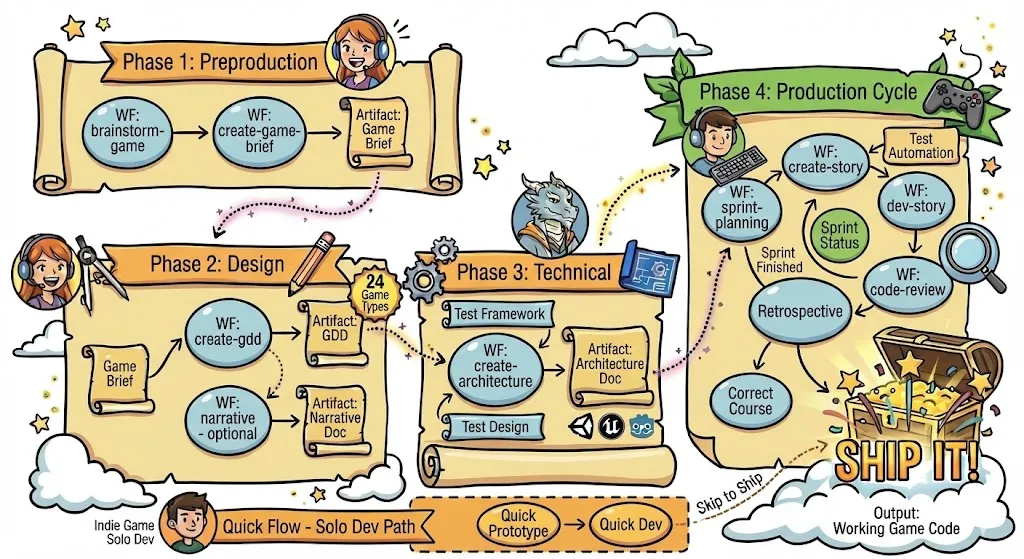
Complete visual flowchart showing all phases, workflows, and agents for game development.
Game Development Agents
Section titled “Game Development Agents”| Agent | When to Use |
|---|---|
| Game Designer | Brainstorming, Game Brief, GDD, Narrative |
| Game Architect | Architecture, technical decisions |
| Game Developer | Implementation, code reviews |
| Game Scrum Master | Sprint planning, story management |
| Game QA | Test framework, test design, automation |
| Game Solo Dev | Quick prototyping, indie development |
Installation
Section titled “Installation”If you haven’t installed BMad yet:
npx bmad-method installOr add BMGD to an existing installation:
npx bmad-method install --add-module bmgdVerify your installation:
your-project/├── _bmad/│ ├── bmgd/ # Game development module│ │ ├── agents/ # Game-specific agents│ │ ├── workflows/ # Game-specific workflows│ │ └── config.yaml # Module config│ ├── bmm/ # Core method module│ └── core/ # Core utilities├── _bmad-output/ # Generated artifacts (created later)└── .claude/ # IDE configuration (if using Claude Code)Step 1: Create Your Game Brief (Preproduction)
Section titled “Step 1: Create Your Game Brief (Preproduction)”Load the Game Designer agent in your IDE, wait for the menu, then start with your game concept.
Optional: Brainstorm First
Section titled “Optional: Brainstorm First”If you have a vague idea and want help developing it:
Run brainstorm-gameThe agent guides you through game-specific ideation techniques to refine your concept.
Create the Game Brief
Section titled “Create the Game Brief”Run create-game-briefThe Game Designer walks you through:
- Game concept — Core idea and unique selling points
- Design pillars — The 3-5 principles that guide all decisions
- Target market — Who plays this game?
- Fundamentals — Platform, genre, scope, team size
When complete, you’ll have game-brief.md in your _bmad-output/ folder.
Step 2: Design Your Game
Section titled “Step 2: Design Your Game”With your Game Brief complete, detail your game’s design.
Create the GDD
Section titled “Create the GDD”Start a fresh chat with the Game Designer agent.
Run create-gddThe agent guides you through mechanics, systems, and game-type-specific sections. BMGD offers 24 game type templates that provide genre-specific structure.
When complete, you’ll have gdd.md (or sharded into gdd/ for large documents).
Step 3: Plan Your Architecture
Section titled “Step 3: Plan Your Architecture”Start a fresh chat with the Game Architect agent.
Run create-architectureThe architect guides you through:
- Engine selection — Unity, Unreal, Godot, custom, etc.
- System design — Core game systems and how they interact
- Technical patterns — Architecture patterns suited to your game
- Structure — Project organization and conventions
When complete, you’ll have game-architecture.md.
Step 4: Build Your Game
Section titled “Step 4: Build Your Game”Once planning is complete, move to production. Each workflow should run in a fresh chat.
Initialize Sprint Planning
Section titled “Initialize Sprint Planning”Load the Game Scrum Master agent and run sprint-planning. This creates sprint-status.yaml to track all epics and stories.
The Build Cycle
Section titled “The Build Cycle”For each story, repeat this cycle with fresh chats:
| Step | Agent | Workflow | Purpose |
|---|---|---|---|
| 1 | Game SM | create-story | Create story file from epic |
| 2 | Game Dev | dev-story | Implement the story |
| 3 | Game QA | automate | Generate tests (optional) |
| 4 | Game Dev | code-review | Quality validation (recommended) |
After completing all stories in an epic, load the Game SM and run retrospective.
Quick Prototyping Alternative
Section titled “Quick Prototyping Alternative”For rapid iteration or indie development, load the Game Solo Dev agent:
quick-prototype— Rapid prototypingquick-dev— Flexible development without full sprint structure
What You’ve Accomplished
Section titled “What You’ve Accomplished”You’ve learned the foundation of building games with BMad:
- Installed the BMGD module
- Created a Game Brief capturing your vision
- Detailed your design in a GDD
- Planned your technical architecture
- Understood the build cycle for implementation
Your project now has:
your-project/├── _bmad/ # BMad configuration├── _bmad-output/│ ├── game-brief.md # Your game vision│ ├── gdd.md # Game Design Document│ ├── narrative-design.md # Story design (if applicable)│ ├── game-architecture.md # Technical decisions│ ├── epics/ # Epic and story files│ └── sprint-status.yaml # Sprint tracking└── ...Quick Reference
Section titled “Quick Reference”| Command | Agent | Purpose |
|---|---|---|
*brainstorm-game | Game Designer | Guided game ideation |
*create-game-brief | Game Designer | Create Game Brief |
*create-gdd | Game Designer | Create Game Design Document |
*narrative | Game Designer | Create Narrative Design |
*create-architecture | Game Architect | Create game architecture |
*sprint-planning | Game SM | Initialize sprint tracking |
*create-story | Game SM | Create a story file |
*dev-story | Game Dev | Implement a story |
*code-review | Game Dev | Review implemented code |
*workflow-status | Any | Check progress and next steps |
Common Questions
Section titled “Common Questions”Do I need to create all documents? At minimum, create a Game Brief and GDD. Architecture is highly recommended. Narrative Design is only needed for story-driven games.
Can I use the Game Solo Dev for everything? Yes, for smaller projects or rapid prototyping. For larger games, the specialized agents provide more thorough guidance.
What game types are supported? BMGD includes 24 game type templates (RPG, platformer, puzzle, strategy, etc.) that provide genre-specific GDD sections.
Can I change my design later?
Yes. Documents are living artifacts—return to update them as your vision evolves. The SM agent has correct-course for scope changes.
Getting Help
Section titled “Getting Help”- During workflows — Agents guide you with questions and explanations
- Community — Discord (#bmad-method-help, #report-bugs-and-issues)
- Documentation — BMGD Workflow Reference
- Video tutorials — BMad Code YouTube
Key Takeaways
Section titled “Key Takeaways”Ready to start? Load the Game Designer agent and run create-game-brief to capture your game vision.